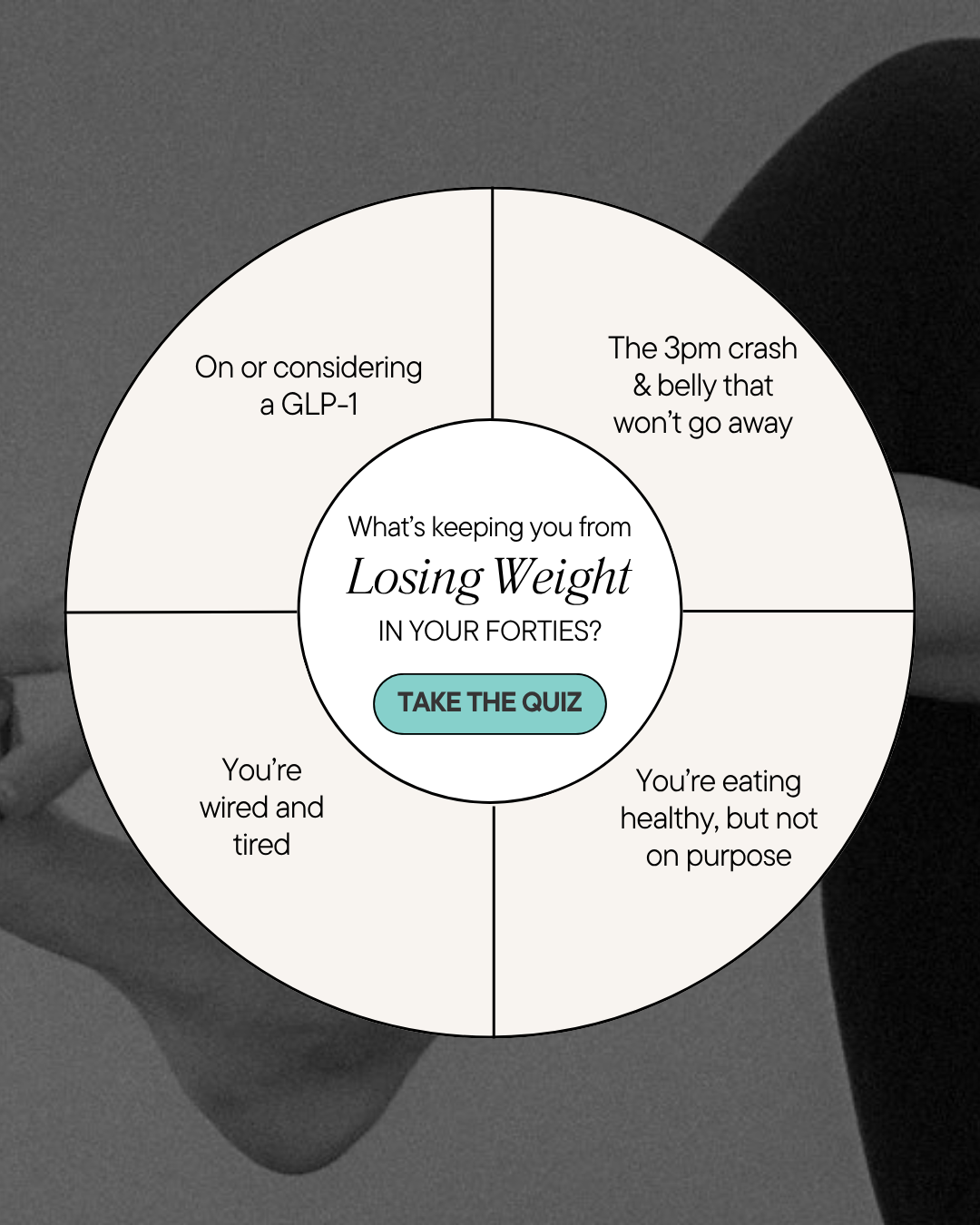
Most women in their 40s stop losing weight for one of four reasons: cortisol staying elevated, macros that were never matched to her body, blood sugar swinging all day, or muscle quietly disappearing. All four look identical from the outside, and the fix for one can make another worse. The right first step depends on which one you have.
You are eating well. You are moving. You cut the wine back to weekends and you are getting your steps in, and the scale has not cared about any of it in eight months.
Between March 2023 and February 2025, 5,621 women filled out my new client assessment before starting with me. Average age, 44. Ninety-six percent wrote the same goal in the box. And 62% rated their stress at a 6 or higher out of 10.
Reading those forms, one after another, year after year, is what convinced me of something. “I’m doing everything right and nothing’s working” is not one problem. It’s four, and they wear the same outfit.
Four blocks that look identical from the outside
The symptoms overlap almost completely. Belly weight that will not move. Exhaustion that sleep does not fix. A 3pm crash you plan your afternoon around. Clothes that fit differently even though the number has barely changed.
A woman whose cortisol is running high and a woman who has never eaten enough protein will describe their week to me in nearly the same words. So will a woman losing muscle on a GLP-1. And the standard advice she gets, which is eat a little less and move a little more, helps exactly one of them and quietly hurts the other three.
Your hormones are part of this. That part is real. Estrogen and progesterone are shifting and the SWAN research found that fat gain accelerates and lean mass declines through the menopause transition itself, not just from getting older. But your hormones are not the whole story, and “it’s my hormones” is not a plan.
Of those 5,621 women, 1,190 marked perimenopausal and 711 marked hypothyroidism. Same boxes checked, four different reasons the scale was stuck.
The Cortisol Block
This one shows up as tired and wired. You are exhausted at 2pm and awake at 2am. Your body is holding weight around the middle even when the rest of you has not changed much, and every time you cut harder or add another workout, it gets a little worse.
Cortisol is a stress hormone, and it does not distinguish between a hard week at work and a hard week of eating too little. Both read as an emergency. Researchers at Yale tested this directly in 59 healthy premenopausal women across four days of lab sessions and found that the women carrying weight centrally secreted significantly more cortisol under stress and reported more chronic stress in their lives.
Which means the woman in this block is under-eating and over-training a body that is already braced.
Katie was 46 when she came to me, teaching PreK on days that started at 7am and often did not end until 9pm, with Hashimoto’s, adrenal fatigue, and 35 pounds she had picked up over four years. She had worked with a nutritionist through her insurance for a full year and gained five pounds. She was eating at or below 1,200 calories a day and, in her words, flat out exhausted. What she needed was more food and real strength work instead of sporadic workouts squeezed in around depletion. Six weeks later her afternoon crashes were gone.
Four different blocks, one set of symptoms. Treating the wrong one is why the last three programs did not work.
The Macro Mismatch Block
You eat healthy. Grilled chicken, salads, Greek yogurt, the works. Nobody has ever handed you a number.
This is the most common block I see, and the most fixable. Of the 5,606 women who answered the macro question on my assessment, 54% had never tracked macros in their lives. They were eating well in the general sense and eating far too little protein in the specific sense, which after 40 is the difference between losing fat and losing muscle.
Eating healthy and eating on purpose are two separate skills, and nobody teaches the second one.
Jessica was 45 and spending $120 a month on boot camps, three 60-minute sessions a week plus treadmill work after each one, eating at or below 1,200 calories, tracking every bite in MyFitnessPal. She was getting stronger and the scale would not move. She swapped the boot camps for 30-minute workouts at home and ate well above where she had been, and over six weeks she lost 8.25 total inches while eating more than she could recall eating in her adult life.
The Blood Sugar Block
The tell here is the crash. You are fine until about 3pm and then you would trade a limb for a granola bar. Cravings hit hardest in the evening. You wake up hungry sometimes and not hungry at all other days, and the weight is sitting right around your middle.
Estrogen has a hand in how your body responds to insulin, and The Menopause Society notes that as estrogen falls through the menopause transition the body can become less responsive to it. So the same breakfast that carried you to lunch at 32 leaves you shaky by mid-morning at 46, and the afternoon becomes a series of small decisions you are making on a blood sugar dip rather than on a plan.
What happens at 3pm was set at 7am, by whether protein and fiber were in the first meal of the day or whether it was coffee and a banana.
Amber spent seven years on keto and intermittent fasting, five of those years eating one meal a day, going up and down the same 10 pounds with weekends falling apart because she was tired of feeling deprived. Week one on a real structure she had more energy and less bloating, and she has since said she has never once felt deprived.
The Muscle Preservation Block
This is the quietest one, and it costs the most over time.
The Office on Women’s Health puts the number at roughly 3 to 5 percent of muscle mass lost per decade starting around age 30, and more for women who are not strength training. Muscle is the tissue that makes your metabolism work, so losing it while you lose weight means you get smaller and softer at the same time.
Two groups sit squarely in this block. Women who have been doing cardio and cutting calories for years without lifting anything heavy. And women on a GLP-1, where the medication does its job on appetite and nobody has told them what to do about the rest. A meta-analysis of nine randomized trials reported in Obesity found that lean mass made up 30.8% of the total weight lost by adults on GLP-1 therapy. That is not an argument against the medication. It is an argument for protein and progressive strength training alongside it, and for having that conversation with your prescriber.
Katy has been with me three and a half years, and she was willing to gain 30 pounds up front to repair her metabolism, which is about as much trust as a person can hand a coach. Her DEXA scan came back with 14 pounds of fat lost, muscle mass increased, and body fat in a healthy range. The part she tells people about is a TSA agent telling her not to hurt anybody with those arms.
How to tell which block is yours
| Block | What it feels like | What’s going on | First move |
|---|---|---|---|
| Cortisol | Tired but wired, 2am waking, weight parked around the middle | A body reading restriction and stress as the same emergency | Eat more, train shorter and heavier, protect sleep |
| Macro Mismatch | Eating healthy for years with no number to work from | Chronic under-eating, especially protein | Get macros built for your body, then hit protein first |
| Blood Sugar | 3pm crash, evening cravings, energy on a roller coaster | Glucose swings on a lower-estrogen backdrop | Protein and fiber at breakfast, then structure the day around it |
| Muscle Preservation | Scale moving, body looking softer, strength dropping | Lean mass leaving alongside the fat | Progressive strength training and enough protein to hold what you have |
| Two at once | Several of the above, all at the same time | Very common after 40 | Start with the one driving the others, usually cortisol or protein |
Plenty of women have two of these running at once, which is why guessing tends to fail. Fixing the wrong one first can make the other one louder.
What to do this week, whichever block you have
Three things hold true across all four, and none of them require you to buy anything.
Get 30 grams of protein into your first meal. Not two eggs. Two eggs is 12 grams and it will not carry you to lunch. This one move steadies blood sugar, supports muscle, and takes the edge off the 3pm decision before you ever get to 3pm.
Stop adding cardio to solve a plateau. If you are stuck and your instinct is to add a fourth workout, that instinct is usually pointing at the wrong lever. Trade one of those sessions for a strength session you load heavy enough to feel the next day.
Find out which block you are in before you change anything else. This is the whole reason I built the quiz. Six months of doing the right work on the wrong problem is the most expensive thing I watch women do.
Take the quiz and find your block
The Forty & Frustrated quiz does one job. It pinpoints the single blocker keeping your weight stuck around your middle and gives you a tailored next step that fits your life after 40.
Take the Forty & Frustrated quiz →
If you already know you are done guessing and you want the whole thing built for you, custom macros, daily 30-minute workouts, weekly meal plans, and me in your corner every day, that lives inside my membership at $79 a month.
xo, Loren


LEAVE A COMMENT
Comments