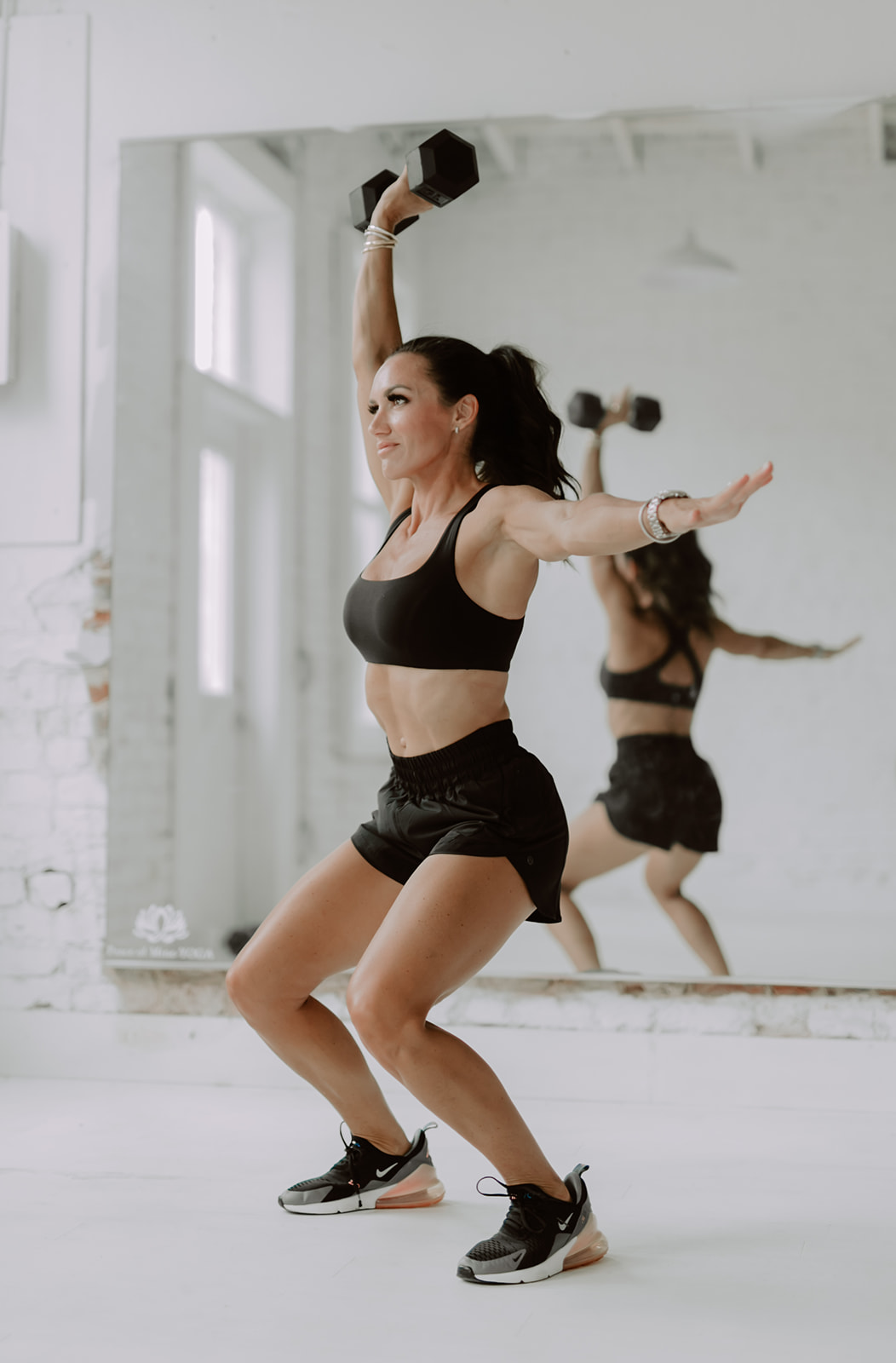
Strength training is one of the most powerful things a woman over 40 can do for her health and longevity. A Harvard study of 147,374 adults followed over 30 years found that 90 to 120 minutes of resistance training per week — two 45-minute sessions or three 30-minute sessions — is linked to a 13% lower risk of death from any cause, a 19% lower risk from heart disease, and a 27% lower risk from neurological diseases like Alzheimer’s.
Listen, I need to talk to you about strength training — and I don’t mean in a “lift heavy, ladies!” motivational-poster way. I mean in a this-is-the-thing-that-changes-everything way, and science just caught up to what those of us in the strength training world have been watching happen in real time for years.
A Harvard study published in June 2026 in the British Journal of Sports Medicine followed 147,374 adults across three major long-running health studies for up to 30 years. Researchers tracked weekly resistance training habits and mapped them against actual mortality outcomes, including deaths from heart disease, cancer, and neurological diseases like Alzheimer’s and Parkinson’s. It is the largest and longest study ever conducted on the dose-response relationship between strength training and longevity. And what they found is specific, actionable, and within reach of almost every woman reading this.
This is not about aesthetics. This is not about the scale. This is about the fact that strength training — at a dose most of us can actually hit — is one of the most protective things you can do for the decades ahead. And if you’re a woman in your 40s or 50s who’s been told to “just do cardio,” I want you to sit with that for a second.
What the Harvard Strength Training Study Actually Found
The full study, published in the British Journal of Sports Medicine, set out to answer something the research world had not clearly established: exactly how much strength training matters for how long you live, and whether that relationship changes depending on what you’re trying to protect yourself against.
The headline finding is a specific number. Adults who averaged 90 to 120 minutes of resistance training per week had a 13% lower risk of dying from any cause compared with those who did no strength training at all. That same group saw a 19% lower risk of death from cardiovascular disease, and a 27% lower risk of death from neurological diseases including Alzheimer’s. Two 45-minute sessions per week. Or three 30-minute sessions. That’s the dose.
What the researchers also found is that the relationship between strength training and cancer mortality is different from cardiovascular and neurological outcomes. Even very small amounts of resistance training — as little as 1 to 29 minutes per week — were associated with a 21% lower cancer mortality risk. The cancer benefit doesn’t scale up proportionally the way heart and brain protection does. But it shows up even when you’re barely getting started.
And here’s what I found just as important as those headline numbers: adding more than 120 minutes per week didn’t add more benefit. The mortality risk curve flattened completely above that threshold. We’re not talking about training for hours every day. We’re talking about two or three focused sessions per week, and then you have done the thing.
If 90 to 120 minutes a week is the sweet spot for living longer, the question isn’t whether you have time to strength train. The question is whether you have time not to.
Why This Hits Different for Women Over 40
Women in perimenopause and early menopause lose estrogen, and estrogen has a significant protective effect on muscle mass. When it declines, the body becomes less efficient at building and holding onto lean muscle, which means the window of opportunity to protect your muscle — and your long-term health — is not neutral with age. It gets smaller.
A 2024 analysis of over 4,800 adults published in MDPI Biology found that people who performed about 90 minutes of strength training per week had telomeres — the protective caps on chromosomes that function as a marker of biological age — that were approximately four years younger than their actual age. Strength training is not just changing how your body looks. It is changing how your body is aging at the cellular level.
Muscle mass matters beyond just strength. According to research published in the Journal of Cachexia, Sarcopenia and Muscle, low muscle mass is associated with a 30% higher risk of all-cause mortality. When estrogen drops and muscle starts to go — through years of under-eating, chronic cardio, and no progressive resistance work — women aren’t just losing the ability to feel strong. They’re losing a protective biological layer.
This is why I talk about strength training constantly in my community. Not because I want everyone to look a certain way. Because I have watched what happens when women in their 40s and 50s start strength training consistently, fuel their workouts with enough protein and real carbohydrates, and stop treating their body like the enemy. Body composition shifts. Energy comes back. Labs improve. And the women who felt like they were doing everything right and getting nowhere finally start to feel the return on all that effort.
My client Katy, who has been in VIP for 3.5 years, used DEXA scanning to track her body composition throughout the process. Her results showed 14 lbs of fat lost and measurable muscle mass gained — and a stranger at TSA pre-check told her not to hurt anybody when they saw her arms. That is what three and a half years of consistent strength training and strategic fueling produces. Not a crash. A compound.
How Much Is Enough (and What Counts)
The Harvard study defined resistance training broadly — and that’s actually good news. The activities that counted included weightlifting, yes, but also bodyweight movements like pushups, squats, and lunges. You do not need a gym membership. You do not need an hour a day. You need progressive resistance applied consistently across the week.
Here’s what 90 to 120 minutes actually looks like in practice:
Two 45-minute sessions per week. This is the minimum effective dose for the full mortality benefit the study identified. A Monday and a Thursday. A Tuesday and a Saturday. Pick two days you can protect and build from there.
Three 30-minute sessions per week. This is the structure we use inside the FASTer Way program, and the research confirms why it works. Three focused days — not marathon sessions, not daily exhaustion — with strategic rest and recovery woven in. My client Jessica Clarke, 45 years old, swapped her three 60-minute boot camp sessions for 30-minute FASTer Way workouts. She lost 10 lbs and 8.25 inches, and described the program as feeling like magic — she was eating more than she had in her adult life and getting better results with less time in the gym.
A combination that adds to 90 or more minutes total. Some weeks your schedule is going to compress two sessions into one longer one. Some weeks you’ll get three shorter ones in. The research supports the total weekly dose, not a rigid daily structure. Consistency across the week matters more than any single workout being perfect.
What does NOT count toward the protective benefit: hours of chronic cardio with no resistance component. This is the piece that is hard to hear for women who have been doing spin classes and long runs for years and cannot figure out why their body composition isn’t responding. Cardio has enormous cardiovascular benefits, and the Harvard study confirmed that combining aerobic exercise with strength training produces the lowest mortality risk of any group studied. But aerobic exercise alone, without the resistance component, does not provide the same muscle-protective or neurological benefits. You need both, and if you have to prioritize, make sure strength is in the rotation.
What This Means If You’re Just Starting
One of the most reassuring things about the cancer mortality findings in this study is how quickly some protection shows up. Even 1 to 29 minutes of resistance training per week was associated with a 21% lower risk of cancer-related death. The starting bar is lower than most people think, and the benefit does not require perfection.
If you have never strength trained, or if you’ve had a long gap and feel like you’re starting over, here is the most important thing I can tell you: your body will respond. I see this in my community constantly — women who haven’t lifted anything intentionally in years, who feel like their metabolism is broken, who have been doing all the things and getting nowhere. When they add progressive strength training and pair it with the right nutrition strategy, things start to change.
Start with bodyweight. Pushups, squats, lunges, and hip hinges require no equipment and count as resistance training. If you cannot get to a gym or don’t have dumbbells yet, bodyweight is a real starting point, not a consolation prize.
Add progressive resistance over time. The word “progressive” is key. Your muscles need to be challenged at a level that forces adaptation, and that stimulus needs to increase gradually as you get stronger. This is why a structured program matters more than random workouts.
Fuel the work. Women over 40 who are under-eating and then trying to strength train are fighting themselves. Protein supports muscle repair and retention. Carbohydrates fuel the actual workout. If you are chronically under-fueled, you are not going to get the adaptation you’re working for — and you are going to feel exhausted and wonder why strength training isn’t “working.”
Track your results beyond the scale. Body composition changes and strength gains do not always show up on the scale first. Measurements, how your clothes fit, and how you feel under load are all legitimate markers of progress that the scale misses entirely.
Ready to Start a Strength Training Program Built for Women Over 40?
The FASTer Way 6-Week New Client Experience is a group coaching program that combines 30-minute daily strength workouts, customized macros, and carb cycling in a structure designed specifically for women whose bodies are not responding the way they used to. Every workout is 30 minutes. Every meal plan is built around fueling your training, not starving through it. And it comes with a 30-day satisfaction guarantee — if it’s not the right fit within the first 30 days, you get a full refund.
Start my 6-week strength training & nutrition program!
Frequently Asked Questions
How much strength training do women over 40 need per week?
According to a Harvard study published in the British Journal of Sports Medicine in June 2026, the optimal range for longevity benefits is 90 to 120 minutes of resistance training per week. That translates to two 45-minute sessions or three 30-minute sessions. The study found no additional mortality benefit above 120 minutes, so more is not better — consistency within that range is what matters.
Does strength training help with perimenopause?
Yes. Strength training helps counteract two of the most significant physical changes in perimenopause: declining estrogen (which reduces the body’s ability to build and hold lean muscle) and increasing cortisol (which promotes fat storage, especially around the midsection). Progressive resistance training preserves and builds muscle mass, improves insulin sensitivity, and supports better sleep and energy — all of which are disrupted during perimenopause.
Can I strength train at home without a gym?
Yes. The Harvard longevity study explicitly counted bodyweight movements like pushups, squats, and lunges alongside weightlifting. If you have a set of dumbbells and consistent programming, you have everything you need to hit the effective weekly dose. A structured program matters more than a physical location.
What if I’ve never strength trained before?
Start with bodyweight movements and build from there. Even very small amounts of resistance training — as little as one to two sessions per week at low volume — showed a 21% lower cancer mortality risk in the Harvard study. You do not need to start at the full 90-minute weekly dose. Starting is the priority, and progressive overload comes after you’ve built the habit.
Does strength training replace cardio for women over 40?
No, and the Harvard research confirms this clearly. The lowest all-cause mortality risk was observed in women who combined regular strength training with substantial aerobic activity. Cardio has distinct cardiovascular and metabolic benefits that strength training does not fully replicate. The goal for most women over 40 is to make sure strength training is in the rotation alongside whatever aerobic movement they’re already doing — not to choose between them.
Is 30 minutes of strength training enough to see results?
Yes, when done consistently with progressive overload and appropriate nutrition. Three 30-minute sessions per week falls within the 90-minute weekly threshold the Harvard study identified as the optimal longevity dose. The 30-minute structure is specifically what the FASTer Way program is built around, and the results my clients see — in body composition, strength, and energy — are consistent with what the research supports.


LEAVE A COMMENT
Comments