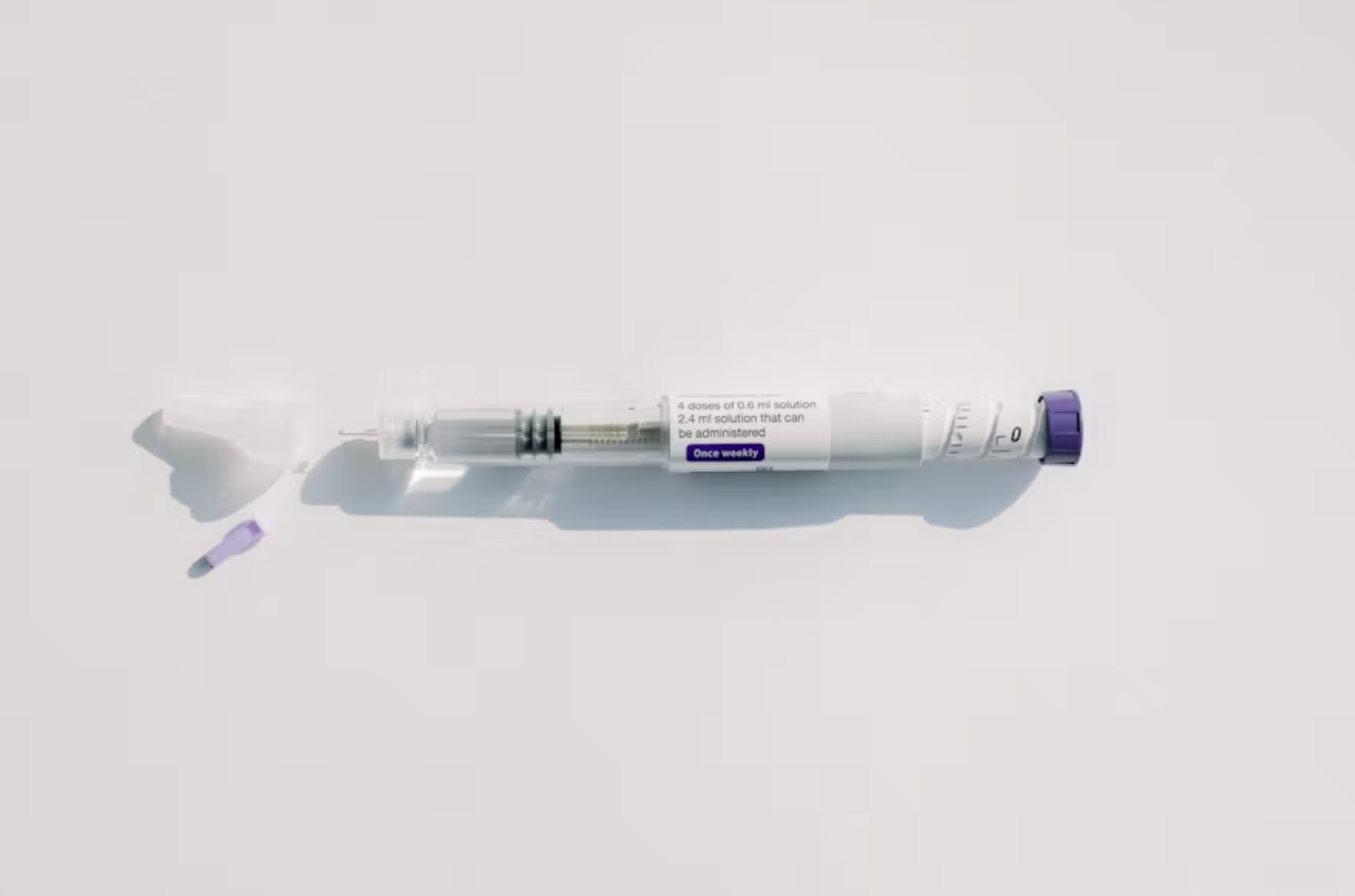
On a GLP-1, muscle is the thing worth gaining. For women over 40, close to 40% of the weight lost on semaglutide in trial data came from lean tissue, and two-thirds of the weight comes back within a year of stopping. Protein and strength training, built while the medication is working, are what hold the result.
GLP-1s work. I’m not here to debate that. Roughly a quarter of the women who follow me are on one or thinking hard about starting one, and I have never once made fun of a single one of them for it.
What I will say is that the medication buys you a window, and what you put inside that window is yours to keep.
One thing before we go further. I’m a certified health coach, not a doctor, and none of this is medical advice or a reason to change your dose. Your prescribing provider owns that conversation. What I coach is the part that happens between the injections, the food, the training, and what your body is made of when the prescription ends.
What a GLP-1 does, and what it leaves to you
A GLP-1 medication copies a hormone your gut already makes. It slows how fast food leaves your stomach, it tells your brain you’re full sooner, and it steadies the blood sugar swings that drive the 3pm crash and the 9pm pantry lap. For a lot of women, it’s the first time the constant mental chatter about food goes quiet.
That quiet is the whole point. It’s also what makes the next part easy to miss.
Because the medication cuts how much you eat, food quality carries more weight than it did before, and clinicians working with GLP-1 patients describe protein, fiber, and hydration as the priorities when someone can only get through half a plate. The drug lowers your intake. It does not tell your body which tissue to give up, and it does not teach you a single habit you’ll still have in eighteen months.
Those two things are the ones you build.
Why being over 40 changes the math
I’ve collected 5,621 new client assessment forms since March of 2023. The average age on those forms is 43. Ninety-six percent list fat loss as the goal. The average stress score is a 6 out of 10.
Here’s what almost none of them are: overfed.
Most of the women writing to me at 43 have been cutting for years. They’ve done the 1,200 calories, the fasting windows that stretched longer every month, the cardio that was supposed to earn something back. Amber Jacquin came to me at 41, four years into perimenopause, after seven years of keto and intermittent fasting with five of those years eating one meal a day. She was disciplined. She was training. She went up and down the same 10 pounds the entire time.
That’s the body a lot of women bring to their first injection. Already under-fueled, already short on muscle, already running a nervous system at a 6. Then you add a medication that drops intake further, and the tissue your body reaches for first is the tissue you spent the last decade failing to build.
Amber ate more with me, not less, and lost 12 pounds in the months that followed. Her words, not mine: she never once felt deprived.
Muscle is the thing worth gaining
This is the part I wish every woman heard before her first dose.
In the STEP 1 trial of semaglutide, lean mass dropped by nearly 7 kilograms against a total weight reduction of 15.3 kilograms, which works out to about 45% of everything lost coming from lean tissue, and across the wider body of research the proportion runs anywhere from roughly 15% to 60% depending on the study. Clinicians use a 25% lean-loss share as the general line for judging whether lean loss is running high.
So the scale moves. It moves beautifully. It just will not tell you which half of the loss was fat and which half was the muscle holding your metabolism up.
Kirstin Cook is the clearest example I have of why the scale is the wrong instrument. She came to me at 40 after seven straight months of heavy lifting with a personal trainer, three to four sessions a week, 60-pound circuits, InBody scans confirming she was building muscle, and a scale that would not budge an inch. She was skeptical of me. Fair. In her first six weeks she lost 10.5 pounds and 7.75 inches, gained half a pound of muscle, dropped 3.8% body fat, and moved her visceral fat from 12 down to 9. She’ll tell you the visceral number is her favorite stat in the whole thing, and she’s right, because that’s the one the scale could never have shown her.
The scale will tell you the weight came off. It will not tell you what came off with it.
What happens when the medication stops
The STEP 1 trial ran an extension that followed participants for a full year after semaglutide was withdrawn, and on average they regained two-thirds of the weight they had lost, with the cardiometabolic improvements drifting back toward baseline right alongside it. Mean weight loss at week 68 was 17.3%. By week 120, a year off the drug, participants sat 5.6% below where they started.
Read that as biology, not as a character flaw. Appetite suppression was doing the work pharmacologically. Take the pharmacology away and hunger comes back, sometimes fast, sometimes hard, and if there’s no muscle underneath and no habit already running on autopilot, there is nothing to hold the line.
Which is the argument for building now, while hunger is quiet and the work is easier than it will ever be again.
I put everything I’d do on a GLP-1 into a free guide, the protein and fiber priorities, the movement minimum, what to do about nausea and constipation, the daily checklist, and a real exit strategy for when you’re ready to come off it. No cost, just your email.
Download my free GLP-1 Guide →
What to gain at the table
Protein first, at every single meal. Not protein eventually, not protein when you remember. The working recommendation for preserving lean mass on GLP-1 therapy sits above 1.2 grams per kilogram of body weight daily, spread evenly across meals rather than stacked into dinner. Your number depends on your body and what you’re training for, which is why my clients get a custom target instead of a rule of thumb. Build the plate around the protein and let everything else fill in behind it.
Fiber daily, added slowly, with water to carry it. Fruit, vegetables, beans, oats, chia. This is what keeps digestion moving when the medication has slowed everything down, and it’s the difference between comfortable and miserable.
The side effects most women describe, nausea, constipation, reflux, that heavy feeling like food is sitting in your chest, tend to spike when you start or step up a dose, and clinical guidance addresses them right alongside the nutrition recommendations. The basics move the needle more than anything. Smaller portions eaten slower, protein even when nothing sounds good, water earlier in the day rather than chugged at 9pm, electrolytes if you’re walking more or feeling wrung out, and a walk after meals, which does more for digestion than anything else on this list.
Fatigue is the one women misread most. It gets filed under “the medication,” when a lot of the time it’s under-eating wearing a costume.
If anything feels severe, persistent, or frightening, that’s a call to your prescribing provider, not a comment section.
What to gain in the gym
Strength train like it’s your job. The 2025 joint advisory from the American College of Lifestyle Medicine, the American Society for Nutrition, the Obesity Medicine Association and The Obesity Society put strength training at a minimum of three times a week alongside 150 minutes of aerobic activity for people using these medications. Full body. Squat, hinge, push, pull, core. Progressive, meaning the weight goes up over time and not just the reps.
Do not skip it because the scale is already moving. The scale moving is exactly the condition under which muscle is most at risk, and lifting is the only signal that tells your body to hold onto it.
Track body composition, not body weight. Get an InBody or a DEXA scan at baseline, before you’re deep into it, and retest every 12 to 16 weeks. That scan is the only thing that will tell you whether you’re gaining ground or quietly losing the muscle you’ll need on the other side.
Katy Privon has been with me three and a half years. She was willing to gain 30 pounds early on to repair her metabolism, which is the bravest thing a woman in this space can agree to. Her DEXA scan this January came back with 14 pounds of fat lost, muscle mass up, and body fat in a healthy range. A TSA agent told her not to hurt anybody with those arms. That’s what three and a half years of building looks like.
Where to go from here
Sarah Butler put it better than I can. After a year with me she wrote, “I can tell you all about what I lost (inches, fat, weight) BUT I want to tell you about what I GAINED: strength, positive mindset, knowledge about exercise and nutrition, a supportive coach and community, confidence, energy, progress towards my goals.” Her capital letters, not mine.
That’s the list. That’s what’s available in the window.
My membership is built for exactly this part. Custom macro targets so you know what your body needs instead of guessing, strength training programmed to build and hold lean muscle, full diet phasing so you understand maintenance and reverse dieting before you need them, and daily accountability with me while you do it. It’s $79 a month with code vip2026 at checkout, and that $20 discount comes off every month, not just the first one. No contract, cancel anytime.
You’ve already done the hard part of starting something. I’d love to help you make it stick.


LEAVE A COMMENT
Comments